
From Product to Persuasion: Building Startup Messaging That Works

Your product may be the most groundbreaking tool in the world. Unless you make the people who need it understand that, it doesn’t have a future.
Getting people to understand is not an inherent skill for everyone.
But it’s a technique everyone can apply.
We landed three significant paying clients in the first month, and our list of leads was so long that we had to add a prioritization mechanism so we could focus on the best fits.
I'll share with you the steps we took to create a persuasive messaging strategy.
We defined the brand by describing our mission, vision, and product.
We defined the ICP through research: who are they, what is their job, what are their goals, what are their motivations?
We identified the factors that keep them from reaching their goals: external / market, internal constraints, personal blockers.
The following are critical steps that startups often skip:
We made ourselves aware of how these hindering factors actually impact our ICP.
The idea is to put yourself in their shoes, so you can see the conflict from their perspective. In other words, look at it from the inside, not as a product provider from the outside.
Your ideal client experiences the challenges, while you only perceive them. To develop messaging that resonates, you need to understand what they experience.
Finally, to position ourselves as solution providers, we asked:
What needs to change in how our ICPs view the experience to make them interested in our product?
This provides the basis for messaging and the angle for persuasion.
If you are a startup going to market with your product, don’t neglect the last two steps.
They are critical for your audience to understand the value of your offer to them.
What Research Shows About Startup Success
At Onchain, we wanted to know why so many projects in the industry fail after launch despite offering impeccable tech. So, we did our research. It’s more than 90%!
Okay, Web3 may be a bit extreme. But the symptoms are similar in other startups like FinTech, data processing, and even AI. And so are the factors that bring them to success.
So, here are a few findings:
Two of the five growth killers we identified can be applied in every industry.
Your story doesn’t stick in two minutes. It’s critical that you pick the right story that will ‘stick’ with investors. A story that helps them understand they’ll get fast ROI. Later your audience needs to hear another story – actually many different stories. One that shows they can trust you, one that shows what’s in this for them, one that highlights your uniqueness, and so on.
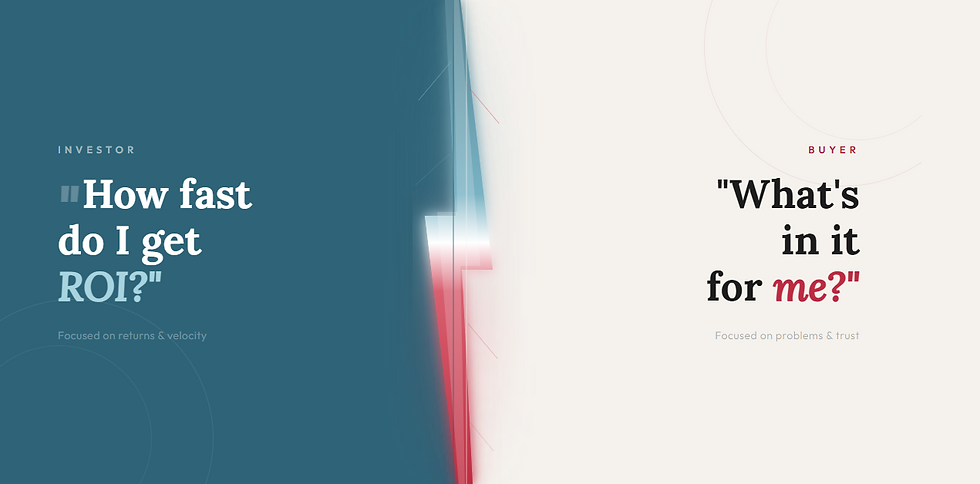
Your messaging sounds like everyone else’s. You’re not the only one who’s identified a challenge and developed a solution. The more the market yearns for it, the more solutions will appear. They all claim to be cutting-edge, advanced, streamlined, fast, intuitive, and all these wonderful words. Then why should anyone choose yours? Differentiation requires saying something others can't or won't say and backing it up with substance. It’s based on a complete and deep understanding of the audience’s needs, the product details, and what the market offers.
Successful projects have good tech AND three other attributes.
We compared highly successful projects, including traditional tech firms that integrated Web3 tech, and identified what they had in common. Two out of three are relevant in any startup:
A compelling vision
Clear positioning
I’ve also worked with enough startups to confirm that positioning and messaging is a sore spot for many.
The ones that succeed aren’t those who offer the best solution. But the ones that know how to position it in the right place with a clear, specific message their audience needs to hear.
Choosing the Right Content Professional
Now that the importance of messaging is clear, the next question is how to develop it and who should do it. You obviously need a content professional.
But how do you choose the right one?
There are sooooo many of us out there. We come in all shapes and sizes.
And I’m sure most are worth their money.
So, let’s start with YOU.

Before you reach out to anyone, define what YOU need.
Start by answering these 3 questions to yourself:
Do you need someone who can work in a void and independently develop messaging, voice, and campaigns? Or do you have a style guide, messaging doc, and/or content marketing plan?
Do you offer a common product in a highly competitive environment? Or do you operate in a niche industry offering a unique solution?
Do you need huge amounts of content in a short time, or do you need the best message that aligns with regulations and other constraints?
This helps you set your priorities and figure out where you need to focus your attention before you reach out to anyone.
Settled on these? Start screening.
We all have our unique strengths and skill sets. The better they fit your needs, the higher your ROI.
The Reality Behind Content Work That Drives Results
You’re sure that your product or tool is going to revolutionize the industry!
And you’ve chosen a content strategist that fits your needs.
What now? How do you get started?
Does that person simply sit down and magically put words together that sell?
Many people still seem to think so. But that’s not what happens.

Before you let them write a single word, make sure they understand deeply:
Your audience
Your product
Your market
Provide all the info you can and let them ask. And then ask again. And again.
To create a focused, consistent message that your ICP will associate with you, this person needs to get the whole big picture and the nitty-gritty details.
Don't rush this phase. You'll save on editing later.
But that’s still a few steps away and a topic for another post.
Now it’s time to find the stories that get your audience’s attention and persuade them.
The Role of Stories in Startup Messaging
A professional content person will first conceptualize clear messaging for your brand.
Writing and creating the actual content make up only about 20% of the work.
💡Research and learning take the most effort.
💡Defining the positioning and messaging is the most critical part.
💡Strategizing is when you move from the theoretical concept to the practical output.
You can view it as putting all the info about audience, product, and market into a squeezer and pressing out the juicy parts. This is the raw material for the stories that the copywriter will tell and adapt to the various channels.
David Garfinkel identified six categories of persuasion stories, which he lays out in his book “The Persuasion Story Code”.
Each category includes four different types. That makes 24 types of story - a lot of options.
Not every story is suited for every brand, or audience, or market. And in most cases, you’ll tell several stories.
People who don’t know your product need to hear a different story than those who aren’t even aware of the problem you solve.
The story you tell those who have never heard of your brand will differ from the one you tell loyal customers about a new product.
Same message, different story.
Are you aware of the stories your brand harbors? And which ones to tell to whom?
Let's find and tell them.


Comments